Lodi Fought Back: The Revolutionary S.J. & S.N. Rail Road
by Alane K. Dashner, Explore Lodi
How do you feel about the Union Pacific trains that thunder north-south through Lodi?
Do you really, really hate them? Not just the loud blasts at every intersection, but do you loathe the train cars themselves, and wish evil to the people who own them?
If you’d been alive in Lodi 150 years ago, that’s probably exactly how you’d have felt.
There was a time when we angry Lodians rose up to fight against California’s “Big Four” railroad monopoly founded by Stanford, Crocker, Huntington, and Hopkins. Today’s Union Pacific, running north-south, is a descendant of their empire.
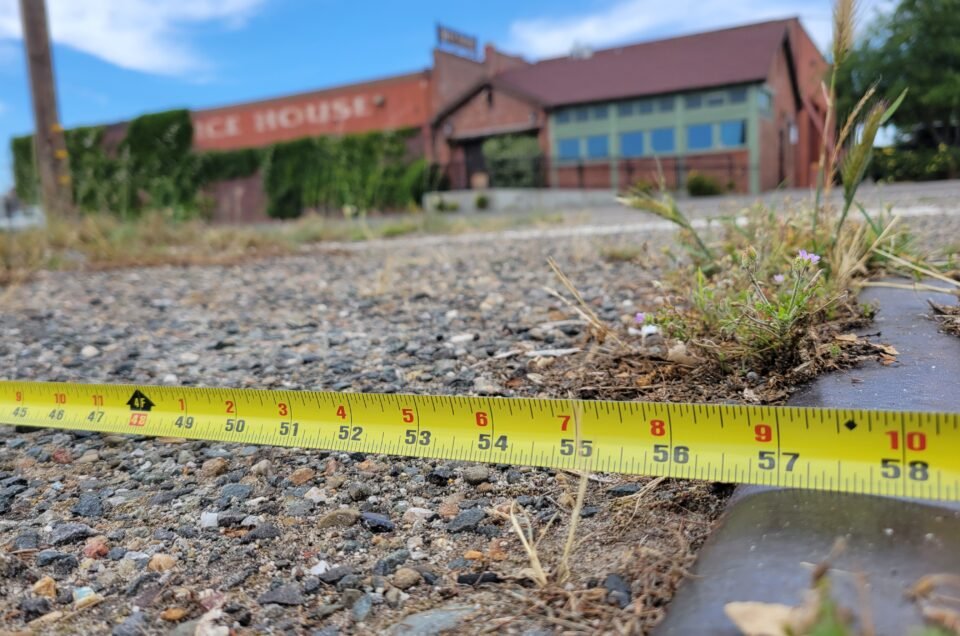
But those mysterious east-west tracks crossing Lower Sacramento Road near the Woodbridge Masonic Cemetery? They ring hollow from our doomed railroad revolution…
Back then, the big guys had us over a barrel
In the 1870s, America’s farmers had a problem.
Once they harvested their crops, they couldn’t afford to ship them to market.
Frustrated farmers nationwide united in the Grange movement, attempting with limited success to fight the railroad monopolies’ high loading and transport fees.
A bountiful crop selling for high prices at market was no reason for a California farmer to celebrate: The Big Four would strategically raise their transport fees just enough to funnel the farmer’s profit into their own pockets.
The Big Four had it all locked up. Lodi-area farmers who evaded rail fees by bumping their grain wagons over dirt roads to the port of Stockton for water transport were charged up to a $100/day toll. Desperate farmers took out loans from banks that were staffed by railroad shills. Attempts for legal redress were blocked too: The Big Four generously bribed judges.
American ingenuity, Mokelumne style
Farmer Jacob Brack lived west near today’s Woodbridge Ecological Reserve. In 1881 Jacob had a brilliant thought: “Why should I pay sky-high transport fees? I live right on the Mokelumne River…”
He bought a steam-powered riverboat. Finding that his route down the Mokelumne directly to San Francisco markets was faster and cheaper than the water route from Stockton to San Francisco, Jacob began telling his friends in Woodbridge and Lodi. Soon grain wagons were lined up on Woodbridge Road and the working community of Brack’s Landing was born.
Why stop at water commerce?
Intoxicated with their early success in outfoxing the Stockton watermen, our local farmers and merchants dreamed bigger.
What we needed was our own railroad connecting Brack’s Landing eastward through the grain fields up to the foothills. In a show of defiance against the Big Four’s Central Pacific (now called Union Pacific) rail line running north-south through Lodi, we built our renegade tracks set only 36 inches apart, “narrow gauge,” so they physically couldn’t connect with C.P.’s wider standard-gauge tracks.
We named our audacious dream the San Joaquin & Sierra Nevada Rail Road and solicited bids to construct the line from Brack’s Landing eastward to Valley Springs.
No Chinese need apply
In the 1880s Lodi was not immune to the West Coast’s anti-Chinese sentiments. When a Chinese man who was backed by the Bank of California submitted his bid to build the S.J. & S.N. R.R., the railway bosses refused to open his bid letter. The Big Four may have resorted to “Chinese cheap labor,” but locals here intended “to show President Arthur that railroads can be built without the aid of [Chinese men].” After the bid was awarded, the bosses opened the Chinese man’s letter to find that his bid had been lower than the accepted bid.
Work started on the S.J. & S.N. line
To keep the soft delta peat near Brack’s Landing as firm as possible, track-builders decided against leveling the railbed by cutting into the turf. Instead, an army of men and horses hauled many tons of dirt and gravel to build an elevated railbed. By April 1882, they had leveled six of the eight miles between Brack’s Landing and Woodbridge. Three miles of heavy wooden crossties were in place and 250 tons of steel rails were stacked and ready.
Jacob Brack drove the first spike.
We used to move fast
By today’s standards, it’s astonishing how quickly the new rail line was built. In July its narrow tracks were already laid through Woodbridge – that’s the railbed we see today across Lower Sacramento Road near the Cemetery – then eastward along West Lockeford Street, across the Big Four tracks to Lodi’s Railroad Avenue, and on past the towns of Victor and Lockeford.
Despite irritation that the track-builders took it easy for a distance east of Lockeford, laying tracks not “along the highway” as contracted but inconveniently on the highway itself, the rural communities of Clements, Wallace, Helisma, Norval, and Valley Springs celebrated their exciting new connection to San Francisco. Many of the historic buildings we see today in Lockeford and beyond were built during the narrow-gauge heyday of the 1880s.
Soon all of California marveled that tourists could travel from San Francisco to beautiful Calaveras Big Trees in one day, all by daylight!
The big guys fought back
Stockton merchants were unnerved by our narrow-gauge success and began scheming for how to connect their own city up to the S.J. & S.N. line.
But in challenging the railroad empire built by Stanford, Crocker, Huntington, and Hopkins… we locals “poked the bear.”
The Big Four’s Central Pacific dropped its fees on its north-south line through Lodi. They could afford to undercut our narrow-gauge line as deeply and for as long as needed to drive us to our knees. Imagine the shame and anger of our struggling farmers as they each decided they must use the least expensive route to market, the hated Central Pacific.
The east-west flow of tourists and miners was not enough to offset the S.J. & S.N.’s loss of agricultural business.
The revolution fails
In 1888, the S.J. & S.N. line was rolled into the Northern Railway Company, a subsidiary of the Big Four monopoly. By 1897 the tracks between Brack’s Landing and Woodbridge were abandoned. Today we can still see where the tracks end abruptly at the Woodbridge Grange on Academy Street.
The narrow-gauge tracks from Woodbridge eastward to Valley Springs were converted to the Big Four’s wider standard-gauge.
Jacob Brack spent his last days with his daughter at 122 East Oak Street in Lodi, watching his enemy’s railcars rush north and south, hearing their whistles blast in triumph.
First renaissance: the east-side Kentucky House Branch
The east-of-Lodi tracks, now standard-gauge width, found new life in the 1920s. Up in the limestone-rich foothills, the new Calaveras Cement Company wanted to use that rail line down to Lodi’s depot. The tracks were extended from Valley Springs past San Andreas to Kentucky House and saw heavy use until the 1980s. Many Lodi residents alive today remember those trains.
Vestiges of the Kentucky House tracks can still be seen on Cherokee Lane at Railroad Avenue.
Second renaissance: the west-side Woodbridge Branch
In 1946 General Mills broke ground on the huge Turner Road manufacturing plant that would become Lodi’s biggest private-sector employer. General Mills built tracks northward across Turner Road, connecting the plant with standard-gauge tracks built on the old narrow-gauge railbed next to the Estella Smith house. Railcars full of Wheaties and Cheerios boxes screeched and clanged, forward and backward, day and night, setting up for their ride eastward and driving the Smith family from their home in 1955.
The General Mills plant closed in 2015. Many Lodians lost their jobs and the Woodbridge Branch fell quiet.
Now, we wait
Will there be a third renaissance for the old narrow-gauge railbed?
Some of us hope for a rails-to-trails conversion for the tracks between Woodbridge and downtown Lodi. A “Greenline” feasibility study was completed in 2022.
Others say we have to keep the Woodbridge Branch tracks the way they are, hoping to attract a new manufacturer to the General Mills property.
In response to this writer’s recent inquiry, Union Pacific says they have no plans to remove their tracks between the old General Mills plant and Lodi.
So… what would Jacob Brack do?