Daisy Pleas5 N Sacramento Street, 826 S Church Street
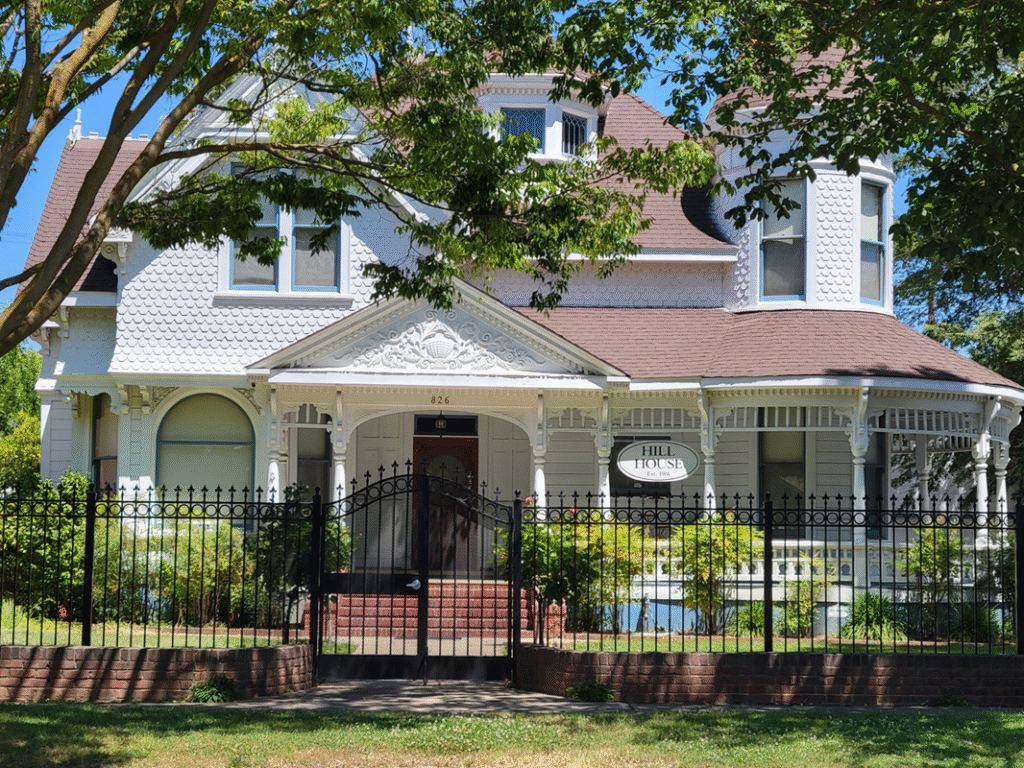
Daisy Pleas (1872-1960) lived most of her 88 years in Lodi. Her mother, Mary Lewis, was a young widow with three children who came from Michigan to marry Lodi farmer Silas Pleas. The couple had three surviving daughters, Daisy, Linda, and Lillian, who were cared for by relatives when their parents died in 1883 and 1885.Daisy was taken in by her older half-sister, Mary Lewis Hill, and Mary’s husband, George, a pioneer watchmaker and jeweler. As soon as Daisy joined the Hill family, she started spending part-time hours at her brother-in-law’s jewelry shop near the northwest corner of Pine and Sacramento Streets, learning all she could about the fine skill of watchmaking.Young Daisy helped Mary Hill save the shop’s inventory during the Big Fire of 1887 by wheelbarrowing the silverware to safety in the Hill home, which was then at 115 S School Street (where the Woolworth Building is now). When Daisy finished her education after ninth grade, she worked full-time in the business, becoming the first female watchmaker in California and one of the very few in America at that time. She also managed the store for 23 years.In 1901 the Hills replaced their original house with a Queen Anne-style Victorian on the same School Street lot. That came to be known as Hill House. To make way for commercial progress in 1948, the Hill family had Hill House divided into two pieces, lifted onto trucks, and reassembled at its current location at 826 S Church Street.Daisy never married. Her career lasted 60 years — from 1890 to 1950, when she finally retired and spent her final ten years active in church and civic activities.
Sources:
newspapers.com/image/628063604Lodi News-Sentinel, Monday, December 12, 1948
Lodi Historian, Volume 1, Number 1, pp 4-6, Spring 1990; Lodi Historical Society.
Lodi Historian, Volume 2, Number 4, pp 53-60, Winter 1991; Lodi Historical Society.
Lodi Historian, Volume 12, Number 4, pp 359-362, Winter 1991; Lodi Historical Society.
Lodi Historian, Volume 12, Number 4, Fall 2001; The Lodi Historical Society.