Laura de Force Gordon, 325 W Pine Street
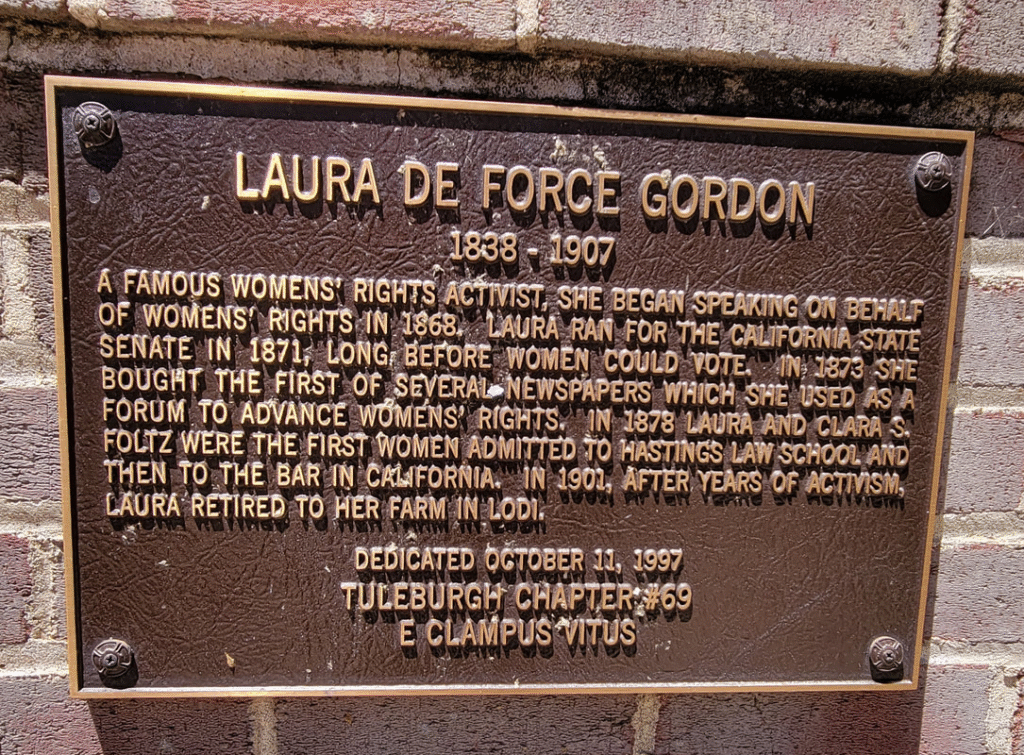
Laura de Force Gordon was born in Pennsylvania in 1838. As a teen, she helped support her many siblings by working as a spiritual medium and lecturer. After meeting Susan B. Anthony in 1854, Laura dedicated herself to women’s rights. With her husband, she worked her way west by giving well-attended lectures in mining camps. By the time they arrived in Lodi in 1870, Laura was a skilled orator.Even though women didn’t have the right to vote, Laura ran for a state senate seat in 1871. The newspapers all ignored her, and she lost. So, in 1874 Laura bought The Stockton Leader and turned it into the country’s first daily newspaper edited and published by a woman.She was a talented speaker and journalist, but Laura wanted more; she saw a future in law. Laura teamed up with fellow writer and activist Clara Shortridge Foltz, and the pair worked with state lawmakers to change the law that barred women from admission to the California bar. Their work culminated in the Woman Lawyer’s Bill in March 1878. Next, she and Clara enrolled in Hastings Law School but were soon asked to leave, allegedly because the rustling of their skirts distracted the male students. The two women sued the school and won, becoming the first two female lawyers in California the following year. Laura had a very successful law practice in San Francisco and Lodi, arguing cases before all-male juries because women weren’t allowed to be jurors. She and Clara were also the first two woman admitted to the bar of the California Supreme Court.When Laura’s husband was exposed as a bigamist in 1878, she quickly divorced him and thereafter referred to herself as a widow.Many historians credit Laura with igniting the women’s suffrage movement in California. She helped found the California Woman’s Suffrage Society in 1870 and later served as its president for 10 years. Unfortunately, in the mid-1880s she also used her oratory skills to become a leading voice in California’s anti-Chinese movement.In addition to voting rights for women, Laura fought for property rights, devising a way around laws that prevented women from owning real estate in their own name. In 1887, several women formed the Woman’s Land Syndicate, appointing Laura de Force Gordon to represent them at auctions. Laura purchased many lots around San Joaquin County on the Syndicate’s behalf. Laura herself held 24 acres near today’s Lodi Grape Bowl that she named the “Woman’s Syndicate Addition to Lodi.” On that property she tried to form a colony exclusively for unmarried suffragists. The colony only succeeded on a small scale.Laura de Force Gordon, Lodi’s most famous citizen, died in her Lockeford Street home a few months before the 1907 Tokay Carnival. Her last words were “Never procrastinate!” Four years later, California women won the right to vote. A historic plaque honoring her is posted in front of The Woman’s Club at 325 W Pine Street.A time capsule buried in San Francisco in 1879 and opened in 1979 contained a message from Laura de Force Gordon who wrote, “If this little book should see the light after its 100 years of entombment, I would like its readers to know that the author was a lover of her own sex and devoted the best years of her life in striving for the political equality and social and moral elevation of women.”